

Google's AI Search Transformation: What the Latest Updates Mean for Your Business
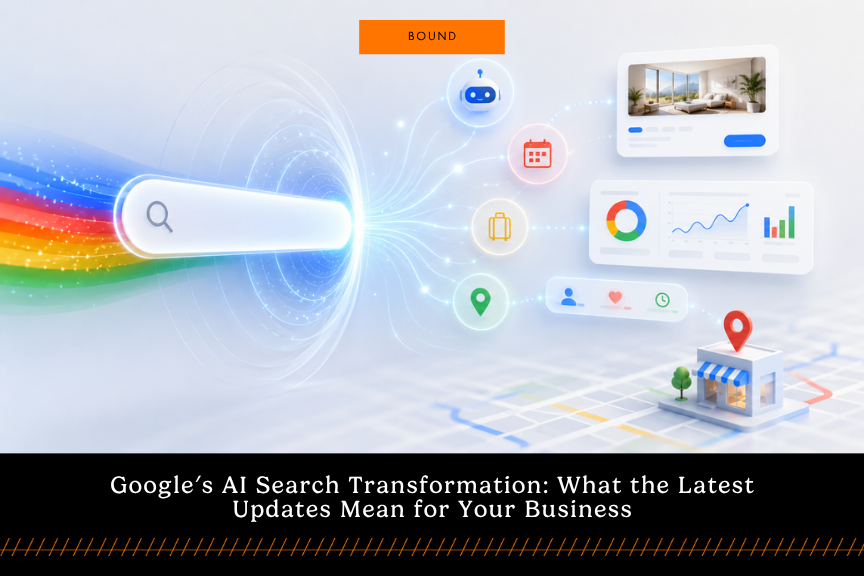
Google’s I/O 2026 updates turn Search into a task engine. With AI Mode, always-on search agents, and in-search booking, customers can compare options and complete transactions without clicking through. Businesses that publish clear, structured answers and accurate local data will get cited, selected, and booked.
Google has announced a major change in how Search works. At I/O 2026, Google showed a future where AI agents don’t just answer questions; they monitor the web, compare options, generate dashboards, and help people book services directly from the results page. If you still treat SEO as a keyword-only game, you will feel the drop-off first in clicks, then in leads.
This article breaks down what changed, what it means for visibility, and how to adapt your content and local presence for AEO (Answer Engine Optimization), SEO, and GEO (Generative Engine Optimization).
What Changed in Google Search (In Plain English)
Google Search is shifting from a “search and click” model to a “search and do” model:
- AI Mode becomes a default experience for more searches.
- Agents can continuously monitor the web for updates and act on a user’s behalf.
- Booking and calls happen inside Search for many local service categories.
- Custom dashboards and interactive tools can be generated per task.
- Personal Intelligence connects Search to a user’s own Gmail, Photos, and Calendar context.
Think of Search less like a library index and more like a concierge with a clipboard.
AI Mode has already surpassed one billion monthly users in its first year, with queries more than doubling every quarter since launch.
How Is AI Search Different from Traditional Search?
For decades, search behavior looked like this:
- Type keywords
- Scan results
- Click links
- Piece together an answer
AI Search compresses that entire process. Users can ask in natural language, include images or files, and get a synthesized response that is ready to act on.
What That Means for Your Content
You are no longer only competing to “rank.” You are competing to be:
- Cited (pulled into an AI answer)
- Selected (used as a recommended option)
- Actionable (connected to a booking, call, or next step)
In other words: clarity beats cleverness, and structure beats vibes.
The Reimagined Search Box: From Query to Conversation
For the first time in 25+ years, Google has fundamentally redesigned the Search box itself. It now:
- Expands as users type
- Accepts longer and more conversational prompts
- Supports multimodal inputs: text, images, files, videos, and even open Chrome tabs as search inputs.
Just as importantly, users can continue the conversation directly inside Search. A single session can flow from question → AI Overview → follow-up in AI Mode → refinement → action, all without leaving the results page.
What this means for content: users no longer arrive with a clean keyword query. They arrive mid-conversation, with context Google has already gathered. Your content must answer the follow-up, not just the initial search. That favors pages with layered detail — direct answer at the top, then specific buyers ask about next (pricing, timing, eligibility, edge cases) further down.
What are AI Search Agents and How Do They Work?
One of the most important shifts is persistent agents that can run continuously.
Instead of a user repeating searches (apartment listings, price changes, event tickets, local services), an agent can monitor sources and alert the user when the criteria match.
Why This Matters for Businesses
If agents are the ones “reading” your site and listings, you need to make it easy for them to extract:
- Availability
- Pricing ranges
- Service area
- Key differentiators
- Policies (refunds, deposits, turnaround times)
- Proof (reviews, certifications, guarantees)
Agents reward businesses that publish complete, consistent, easily parsed information.
Can Customers Books Services Directly Inside Google Search?
Google is pushing more booking flows into the results page, including complex intent queries (group size, timing, constraints).
For some service categories, Google can even call businesses on a user’s behalf, removing friction at the moment of purchase.
Local Takeaway
If your booking experience depends on someone clicking 3 pages deep into your site, you are now fighting upstream. Search is becoming the checkout lane.
Custom Dashboards and Agentic Coding: Search Generates “Mini-apps”
Google is also leaning into dynamic, task-based interfaces. Search can generate interactive dashboards, trackers, graphs, and planning tools using real-time sources.
What That Means for Marketers
Static blog content still matters, but tools and structured assets will increasingly win:
- calculators
- checklists
- comparison tables
- “step-by-step” workflows
- interactive planners
If your content helps an AI system to produce an interface, you become part of the workflow, not just a reference.
Personal Intelligence: Search Becomes Contextual to the Individual
As Search connects (optionally) to a user’s Gmail, Photos, and Calendar, results become filtered through personal context.
This changes the game from “best general answer” to the best answer for this specific person right now.
Business Implication
Generic copy gets weaker. Specificity gets stronger:
- “Same-day HVAC repair in Queens” beats “quality HVAC services”
- “Vegan catering for 30, delivery included” beats “best catering near you”
- “Bridal alterations in 10 days” beats “expert tailoring”
Personal context rewards businesses that publish the exact constraints customers care about.
What This Means for Your Business: Action List
1. Write for Answers First (AEO)
AI systems prefer content that answers quickly and cleanly, which ties directly to AEO.
Add:
- A 40-to-60-word direct answer near the top of key pages
- Short definition blocks (“What is…”, “How does…”, “Cost ranges…”, “Time to complete…”)
- FAQ sections with plain-language questions (not marketing questions)
2. Make Your Site Easy to Extract (SEO + GEO)
AI engines tend to quote structured, unambiguous sections.
Use:
- Clear H2/H3 headings that match intent (“Pricing,” “Service Area,” “What’s Included”)
- Bullets for features and constraints
- Tables for comparisons and packages
- Updated timestamps where appropriate (“Last updated: …”)
3. Treat Local Data Like Inventory (Local SEO)
Agents will pull from structured and third-party sources.
Audit:
- Google Business Profile categories, hours, services, attributes
- NAP consistency (name, address, phone) across major directories
- Booking links, appointment URLs, and contact options
- Photos that show proof of work, not just branding
4. Build “Agent-friendly” Service Pages
Your best service pages should read like a well-labeled product listing.
Include:
- Who it’s for (and who it’s not for)
- Exact service area (neighborhoods, zip codes, travel fees)
- Turnaround times and availability
- Starting price ranges (even if “from”)
- Policies (deposits, cancellations, guarantees)
- Proof (licenses, certifications, outcomes, testimonials)
5. Create Assets AI Can Reuse
If Search generates dashboards and trackers, you want to be the source.
Publish:
- downloadable checklists
- comparison guides (“X vs Y” for your category)
- step-by-step playbooks
- templates (briefs, intake forms, planning sheets)
- calculators (pricing ranges, timelines, ROI)
- calls and direction requests
- bookings/appointment conversions
- branded search volume
- assisted conversions from local and discovery surfaces
- mentions and citations in AI summaries (where measurable)
The New KPI: Visibility Without Clicks
As Search becomes more action-oriented, you may see fewer site visits even when performance improves, because answers and bookings happen inside Search.
Track:
- calls and direction requests
- bookings/appointment conversions
- branded search volume
- assisted conversions from local and discovery surfaces
- mentions and citations in AI summaries (where measurable)
Frequently Asked Questions
What is AEO, and how is it different from SEO?
AEO (Answer Engine Optimization) makes your content easy for AI systems to extract and cite. SEO helps you rank; AEO helps you get quoted inside AI answers. The overlap is structure, clarity, and intent-matching headings.
What is GEO, and why does it matter now?
GEO (Generative Engine Optimization) improves how generative systems summarize and recommend you. It rewards specific, unambiguous information like services, locations, constraints, pricing ranges, and proof, formatted so machines can interpret it cleanly.
Will AI Mode reduce my website traffic?
It can. As Search answers questions and completes actions inside the interface, clicks may drop even when leads rise. Success looks more like calls, bookings, direction requests, and qualified inquiries, not just sessions.
How do I make my content more “citable” by AI?
Add a 40–60-word direct answer near the top, use question-based H2/H3s, write in bullets where possible, and publish decision-ready details (pricing guidance, service area, availability, policies) in plain language.
What should local businesses do first to prepare for agentic booking?
Audit your Google Business Profile and make it match your website: categories, hours, services, attributes, booking links, and contact info. Agents pull from structured, consistent signals, and inconsistencies cost you conversions.
Can I have a conversation inside Google Search now?
Yes. Google's redesigned Search box, launched at I/O 2026, supports longer prompts, multimodal inputs (text, images, files, videos, Chrome tabs), and follow-up questions inside AI Mode. A single session can flow from question to AI Overview to refinement and action without leaving the results page.
Search Is Becoming the Checkout Lane
Search is becoming an agent-led workflow engine. That rewards businesses that are clear, structured, locally consistent, and ready to transact inside Search. If you adapt your content for citation, your listings for accuracy, and your pages for action, you stay discoverable even as the click-based model fades.
The search landscape has shifted. The businesses that win next are the ones built for agents, not just algorithms.
Partner With Concept
Share your details and our team will reach out to discuss collaboration opportunities