

Turning Data into Deals: A Beginner's Guide to Lead Scoring in HubSpot
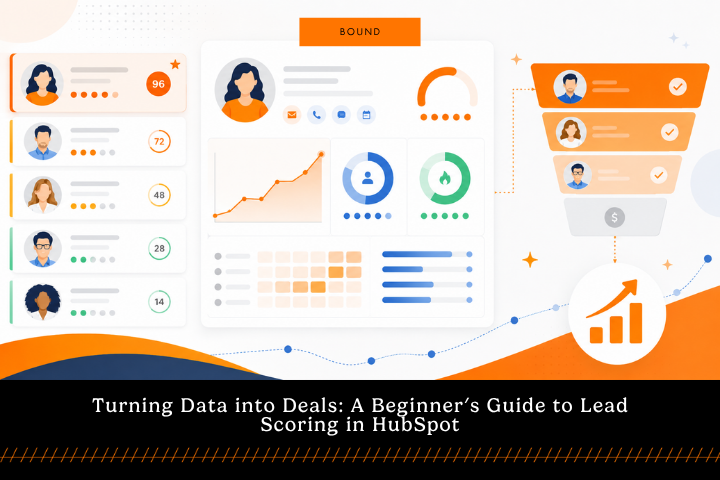
HubSpot lead scoring helps you prioritize outreach by ranking contacts based on how well they match your ideal customer (fit) and how strongly they’re signaling intent (engagement). When scoring is set up correctly, sales calls the right people first, marketing nurtures the rest, and leadership gets a clearer view of pipeline quality.
What Is Lead Scoring in HubSpot?
Lead scoring in HubSpot is a system that assigns points to contacts based on:
- Fit (who they are): company and demographic match
- Engagement (what they do): behaviors that indicate interest or buying intent
- Company size
- Industry
- Location
- Job title / seniority
- Revenue range
- Tech stack (if you track it)
- High-intent page views (pricing, product, comparison)
- Form submissions
- Demo requests
- Email clicks (more meaningful than opens)
- Content downloads
- Webinar registrations/attendance
- Returning sessions within a short window
- Define your ideal customer profile. What company characteristics indicate a prospect is a good fit? Document these criteria so they can be built into your fit score.
- Identify engagement signals. Which actions indicate buying intent? Website visits matter less than demo requests. Prioritize signals that correlate with actual conversions.
- Assign point values. Decide how many points each activity or characteristic is worth. A demo request might be worth 50 points, while a website visit might be worth 1 point.
- Set thresholds. Determine what score makes a lead "sales-ready." This threshold should be based on historical data about which leads actually convert.
- Test and refine. Lead scoring isn't perfect from day one. Monitor which leads convert and adjust your scoring model based on real results.
The output is simple: a faster way to identify sales-ready leads, nurture-worthy leads, and re-engagement opportunities.
What Lead Scoring Actually Does
Lead scoring answers three critical questions about your prospects:
Does this lead need more nurturing? Some prospects are early in their buying journey. They're interested but not ready to talk to sales. Lead scoring identifies these leads, so marketing can continue nurturing them with relevant content.
Is this lead sales-ready? Other prospects have shown enough engagement and fit that they're ready for a sales conversation. Lead scoring flags these opportunities so your sales team can prioritize outreach.
Should we re-engage this lead? Occasionally, a prospect who went quiet shows renewed interest. Lead scoring helps you spot these second chances before they slip away.
Without a systematic approach, these distinctions get lost in the noise. Lead scoring brings clarity to the process.
The Two Components of HubSpot Lead Scoring
Fit Score: Who Is This Contact?
Fit score measures how closely a contact aligns with your ideal customer profile (ICP). It answers: “Are they the right kind of buyer for us?”
Common fit signals include:
A high-fit lead can be valuable even with low activity, because they’re the right target.
Engagement Score: What Have They Done?
Engagement score measures how a contact interacts with your brand. It answers: “How interested are they right now?”
Common engagement signals include:
A high-engagement lead is waving a flag; your model determines how bright that flag is.
The 3×3 Matrix: How HubSpot Categorizes Leads
HubSpot commonly groups leads into nine categories based on Fit (low/medium/high) and Engagement (low/medium/high). This makes prioritization easy without needing a spreadsheet.
High Fit, High Engagement: These are your hottest leads. They're the right fit and actively interested. Sales should prioritize these immediately.
High Fit, Medium Engagement: These prospects match your ideal profile but haven't engaged much yet. Marketing should nurture them with targeted content to increase engagement.
High Fit, Low Engagement: These are potential opportunities that haven't warmed up. They might need a different approach or simply haven't discovered you yet.
Medium Fit, High Engagement: These leads show strong interest but may not be perfect fits. Sales can still explore opportunities, but qualification is important.
Medium Fit, Medium Engagement: These leads are worth monitoring. They could develop into opportunities with the right nurturing.
Medium Fit, Low Engagement: These are lower priority. Focus your efforts on higher-potential leads first.
Low Fit, High Engagement: These leads are interested but don't match your ideal customer profile. Determine if your profile needs adjustment or if these are simply not the right fit.
Low Fit, Medium Engagement: These leads are unlikely to convert. Deprioritize them unless circumstances change.
Low Fit, Low Engagement: These leads should be removed from active outreach or placed in a nurture track for future consideration.
Why Lead Scoring Matters (Beyond “Prioritization”)
Sales: Less Guessing, Faster Conversion
Scoring helps reps call the right leads first. That typically improves conversion rates because timing and fit are stronger.
Marketing: Clearer Feedback on What Creates Intent
Your scoring model becomes a truth test for campaigns and content. If engagement points are being earned by low-quality actions, you’ll see it.
Leadership: Better Pipeline Visibility
When “qualified” has a definition, forecasting gets less emotional and more consistent.
Implementing Lead Scoring in HubSpot
Setting up lead scoring in HubSpot starts by defining what "fit" and "engagement" mean for your business. This requires collaboration between sales and marketing.
HubSpot's lead scoring tools make this process straightforward. You can set up automated scoring rules without needing a developer, and you can adjust them as your business evolves.
Common Lead Scoring Mistakes (And How to Avoid Them)
Mistake 1: Scoring Based on Opinions Instead of Outcomes
Fix: use closed-won and closed-lost data to validate what actually matters.
Mistake 2: Over-weighting Vanity Engagement
Fix: treat blog visits and email opens as lightweight signals unless they stack with higher intent.
Mistake 3: No Recency Factor
Fix: include decay or time-weighted scoring so older interest fades appropriately.
Mistake 4: Setting the Threshold Too High
Fix: if almost no one hits “sales-ready,” your model is blocking pipeline. Lower the bar and iterate.
Mistake 5: One Model for Everything
Fix: if you sell multiple products or serve distinct segments, consider separate scoring models by offer, persona, or lifecycle stage.
FAQ
What is lead scoring in HubSpot?
Lead scoring in HubSpot assigns points to contacts based on fit (how well they match your ICP) and engagement (their actions). It helps teams prioritize outreach, and route leads into sales or nurture flows.
What’s the difference between a fit score and an engagement score?
Fit score measures who the lead is (company size, industry, role). Engagement score measures what they do (pricing visits, demo requests, clicks, downloads).
What is a good sales-ready lead score?
There isn’t a universal number. A good threshold is one that reliably predicts meetings and revenue for your business. Start with a conservative threshold and refine using conversion data after 2–4 weeks.
Should email opens count toward engagement?
Lightly, if at all. Opens can be misleading due to privacy changes. Clicks, form fills, and high-intent page visits are usually better indicators.
How often should you update your scoring model?
Quarterly is a good baseline, monthly if you are running lots of campaigns or changing offers frequently.
Want Concept to Set This Up for You?
Concept can help you build a lead scoring model that your sales team trusts, and your marketing team can optimize, without guesswork. We’ll map your ICP, define intent signals, set thresholds, and implement scoring and automation in HubSpot, so your reps focus on the leads most likely to close.
Reach out to our team today.
Partner With Concept
Share your details and our team will reach out to discuss collaboration opportunities