

EOS and the Discipline of Realistic Targets: How Data-Driven Goal Setting Transforms Business Growth
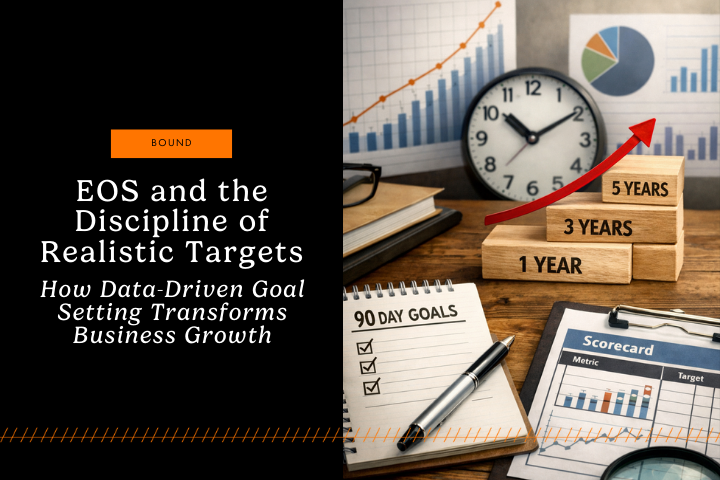
The Entrepreneurial Operating System (EOS) transforms business growth by connecting long-term vision to quarterly execution through data-driven targets. By utilizing Scorecards and Rocks, leadership teams replace hopeful guesses with measurable progress. This approach ensures every initiative aligns with operational reality and predictable revenue scaling.
From Reactive Management to Disciplined Planning
When Concept adopted EOS in 2020, we weren't just implementing another business framework. We were solving a fundamental problem that plagues growing companies: the gap between ambitious vision and executable reality.
Like many businesses experiencing rapid growth, we found ourselves caught between reactive firefighting and scattered initiatives that never quite delivered the results we expected. EOS changed that by introducing the discipline of realistic targets, something we hadn't fully grasped before.
Why EOS Works: Structure Meets Accountability
EOS gave our leadership team a shared system for running the business that moved us from reactive work to disciplined planning and follow-through. The framework's power lies not in its complexity, but in its systematic approach to connecting long-term vision with quarterly execution.
The transformation wasn't immediate, but the results were measurable:
- Clearer company direction through a shared vision that everyone understood
- Stronger leadership alignment on priorities that actually mattered
- Better execution because every goal had a designated owner
- More focus through quarterly Rocks instead of scattered initiatives
- Improved accountability through scorecards and weekly metrics
- Faster problem solving using the Issues, Discussion, Solution (IDS) process
- Better communication through cascading messages that reached every level
- Less wasted time in meetings and more decisions made
- More predictable progress quarter after quarter
The weekly Level 10 meetings became our cornerstone, creating a consistent cadence that kept everyone aligned and accountable. Instead of repeating the same conversations week after week, we started solving issues with process.
Goal Setting Across Time Horizons: The EOS Framework
One of EOS's most powerful concepts is goal setting across multiple time horizons. This isn't about creating more goals; it's about creating the right goals that build on each other systematically.
5-Year Goals: Define the Destination
Your 5-year goals set the long-term vision for where the business must go. These aren't wishful thinking exercises but strategic decisions that guide major investments and create alignment across leadership and departments.
3-Year Goals: Build the Growth Plan
Three-year goals translate the vision into measurable outcomes. They force you to identify the capabilities needed to reach your destination and engage in realistic planning instead of vague ambition.
1-Year Goals: Commit to What Must Happen Now
Annual goals define the most important outcomes for the next 12 months. They set targets the team can execute with available resources and align budgets, hiring, and priorities around those goals.
90-Day Goals: Execute with Discipline
Quarterly Rocks break annual objectives into manageable chunks. They create urgency and focus while preventing drift by reviewing progress every week.
The Discipline of Realistic Targets
Strong companies don't throw out random numbers during annual planning. Realistic targets come from data, capacity, and execution history. EOS helps teams commit to goals grounded in measurable reality rather than optimistic guesswork.
This discipline separates successful implementations from failed ones. When goals are realistic, teams can achieve them. When teams achieve their goals consistently, confidence builds. When confidence builds, bigger goals become achievable.
Planning for Growth: A Practical Example
Let's walk through how this works in practice. Suppose your company wants to achieve 15% growth over the next three years. Here's how the EOS methodology would approach this goal:
Start with the Vision
The vision is clear: 15% growth over three years. But vision without execution planning is just hope.
Back Up the Math Using Data
Before committing to any growth target, you need to understand what's achievable:
-
Review historical revenue trends to understand your baseline
-
Evaluate market conditions and pricing shifts that could impact growth
-
Assess what growth rate looks realistic given your current capabilities
Model the Sales Engine
Growth doesn't happen by accident. It requires understanding and optimizing your sales engine:
-
How many opportunities do you need to create?
-
What is your close ratio today, and can it be improved?
-
What is your average deal size, and is there room for expansion?
-
How long is your sales cycle, and can it be shortened?
-
What volume of pipeline supports your growth goal?
Decide Where Growth Will Come From
Once you understand the mechanics, you can choose your growth strategy:
Option 1: Increase Retention and Expand Existing Clients
-
Focus on client success and repeat business
-
Keep new sales volume steady
-
Improve lifetime value and margin
Option 2: Increase New Client Acquisition
-
Expand marketing and outbound appointment setting activity
-
Open new sales channels
-
Invest in lead generation earlier
Option 3: Do Both, But Plan Resources Now
-
Add capacity in sales, delivery, or support
-
Build systems before demand outpaces execution
Planning Decisions to Make Immediately
With your growth strategy defined, you can make informed decisions about resource allocation:
-
Do you need more sales and marketing channels?
-
Do you need additional team capacity to deliver growth?
-
Do you need stronger retention systems to reduce churn?
-
Do you need new operational processes to scale?
-
Do you need to adjust quarterly Rocks to match the long-term target?
From Planning to Execution: Making It Work
The beauty of EOS lies in its connection between vision and execution. Realistic annual goals come from data, not guesses. Quarterly priorities turn long-term growth into measurable progress.
This systematic approach prevents the common trap of setting ambitious goals without considering the operational reality of achieving them. When your sales process is optimized, and your team understands exactly what needs to happen each quarter, growth becomes predictable rather than hopeful.
The discipline of realistic targets doesn't limit your ambition; it makes your ambition achievable. By grounding goals in data and connecting them to executable quarterly Rocks, EOS creates a framework where consistent progress becomes the norm rather than the exception.
The Best Time to Plan Is Now
Whether you're considering EOS implementation or looking to improve your current planning process, remember that the best time to plan for three and five-year objectives is now. The companies that will thrive in the coming years are those that combine ambitious vision with disciplined execution.
For businesses ready to move beyond reactive management and scattered initiatives, EOS offers a proven path forward. The question isn't whether you can afford to implement it, but whether you can afford not to.
Partner With Concept
Share your details and our team will reach out to discuss collaboration opportunities