

HubSpot Revenue Hub Launched June 16: What Sales Teams Need to Know
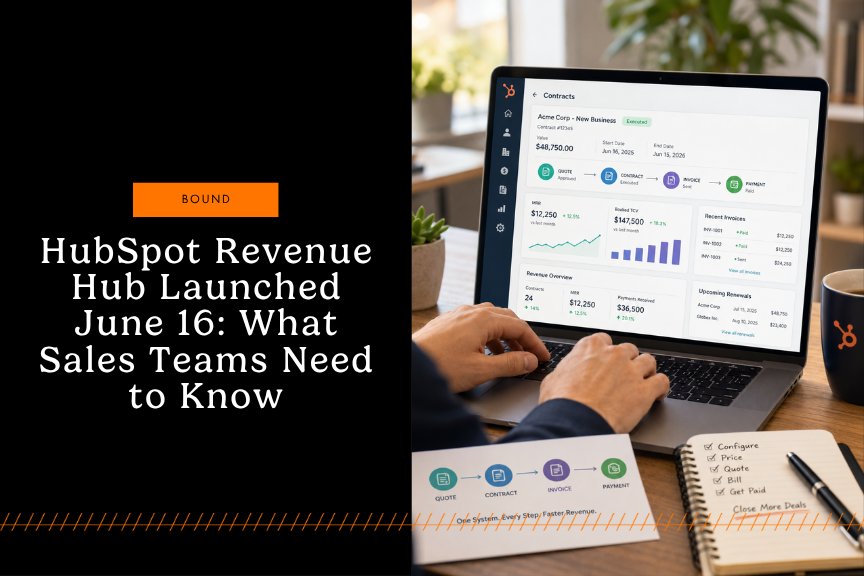
HubSpot launched Revenue Hub on June 16—a unified revenue system designed to solve one of sales' biggest problems: deals stalling between quote and close. According to HubSpot's own data, 86% of deals get stuck somewhere in this process, often because the tools don't talk to each other.
Rather than another point solution, Revenue Hub connects Configure, Price, Quote (CPQ), billing, and payments into a single platform. For sales teams, this means less manual work, better visibility, and faster closes.
What Launched on June 16
Revenue Hub brings three core capabilities together around a central Contracts object:
CPQ (Configure, Price, Quote)
Sales teams can now configure product combinations, apply pricing rules, and generate quotes without leaving HubSpot. Price books automatically assign to deals using filters. Line items support calculations and roll-ups for complex pricing. A rules engine enforces pricing guardrails—you can automate constraints, flag items for review, or block quotes that violate policy. Multi-step approval workflows ensure the right people sign off before quotes go out.
Billing
Invoices are generated automatically from executed quotes, pulling line items and pricing directly into the system. No re-entry. No errors. Customers can add their own billing contact when a quote is sent, eliminating back-and-forth emails about who receives the invoice.
Payments
Customers pay directly from the invoice or through a payment link. HubSpot recognizes the transaction, sends a receipt, and the entire flow stays within the system.
Key Features Now Available
No-Code Quote Builder
Revenue Hub includes a template builder that lets you control exactly how quotes look and feel. Set rules on which fields are editable, add custom modules using code, and embed calculators or meeting links directly into quotes. Your quotes reflect your brand and your process.
Revenue Data Everywhere
Revenue data is now available in the HubSpot UI, in Breeze Assistant (HubSpot's AI), and through business APIs. Sales teams can visualize invoices, track payment status, and trigger automation based on revenue events. Out-of-the-box reports include MRR waterfalls and Booked TCV by month.
Breeze Assistant Gets Revenue Smarts
HubSpot's AI assistant, Breeze, now handles revenue tasks. Sales reps can ask Breeze to create quotes, edit existing ones, or answer questions about revenue status. A dedicated Revenue Agent focuses on closing deals faster and ensuring payment.
Contract Lifecycle Management
When a quote is executed, a contract record is created automatically with all associations—the deal, contacts, company, line items, and invoices. This contract becomes the central hub for the entire customer relationship.
Contracts support lifecycle actions: renewals, changes, and terminations. When a renewal is triggered, a new deal is created automatically. The contract object reflects the lifetime relationship with a customer, tracking upgrades, downgrades, and cancellations.
Flexible Licensing
Not everyone needs a Revenue Hub seat. Using products, approving quotes, and creating quote templates don't require a license. Only quote creation, editing, and sharing require a seat, which helps control costs.
Why This Matters for Sales Teams
The core problem Revenue Hub solves is fragmentation. When your quote tool doesn't connect to billing, and billing doesn't connect to payments, each handoff introduces delay and error. Sales teams lose visibility. Finance can't reconcile. Customers get confused about what they owe.
Revenue Hub consolidates these steps. A quote flows into a contract, which generates an invoice, which accepts payment—all within one system. Revenue data is available to anyone who needs it.
For sales teams, this translates to:
- Faster quote turnaround (no manual data entry between systems)
- Clearer visibility into deal status and payment
- Automated approvals and compliance checks
- Less time on administrative work, more time selling
Not a Replacement, an Integration
Revenue Hub is built to complement, not replace, your ERP. If you use NetSuite, SAP, or another enterprise system for financial management, Revenue Hub integrates with it. The idea is to give sales teams the tools they need without forcing a complete platform overhaul.
You can adopt Revenue Hub incrementally. Start with CPQ, add billing when you're ready, and layer in payments later. If you're evaluating HubSpot as a platform more broadly, understanding how Revenue Hub fits into the larger ecosystem can help. Learn more about HubSpot's capabilities and how it compares to other CRM platforms.
Getting Started With Revenue Hub
Revenue Hub is now available in HubSpot's Sales Cloud. The no-code template builder and rules engine are designed to be accessible to sales operations teams without requiring developer involvement.
If your current quote-to-cash process is creating friction—deals stalling between quote and close, manual data entry across systems, or lack of visibility into payment status—Revenue Hub addresses those pain points directly.
The Bottom Line
Revenue Hub represents HubSpot's bet that sales teams need more than a CRM—they need a revenue system. By unifying CPQ, billing, and payments around a central Contracts object, it removes the fragmentation that slows deals down.
The 86% of deals that stall between quote and close now have a solution. Revenue Hub is here.
Partner With Concept
Share your details and our team will reach out to discuss collaboration opportunities