

Why Your Quoting Process Is Costing You the Deal (Not Your Sales Team)
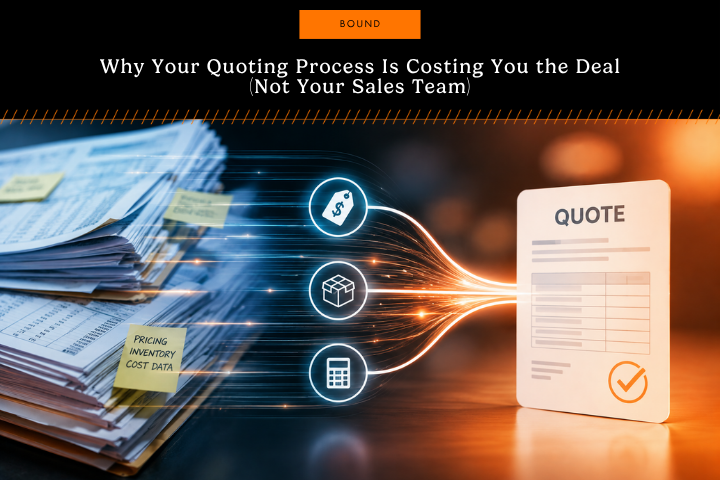
Slow quotes lose deals, not weak sales teams. When pricing, inventory, and cost data live in separate systems, a quote takes 12 to 20 hours to assemble, and the buyer's interest cools before it arrives. Connecting your CRM to real-time pricing, inventory, and finance data cuts that to about 30 minutes. Faster quotes close more deals and signal operational competence buyers notice.
Sales coordinators spend hours assembling quotes across disconnected systems. Pricing lives in one place. Inventory sits in another. Cost data lives somewhere else entirely. By the time a quote reaches the buyer, 48 hours have passed. The buyer's interest has cooled. The deal stalls.
This isn't a sales performance problem. It's a process problem.
The real bottleneck sits in your quoting workflow, not your sales team's ability to close. When quotes take days instead of minutes, you're not just losing time. You're losing deals.
The Hidden Cost of Manual Quoting
Manual quoting adds hours of back-and-forth between sales, operations, and finance before a single quote reaches a buyer.
A sales rep identifies an opportunity. They reach out to operations for pricing. Someone pulls inventory data from a separate system. Another person checks cost information. The quote gets built in a spreadsheet or Word document, reviewed, and sent.
By then, the buyer has moved on.
This pattern shows up constantly in the equipment industry. Sales coordinators manually assemble quotes across disconnected inventory, cost, and pricing systems, and multi-day turnaround becomes normal. Deals stall. Buyers lose confidence. Competitors with faster processes win the business.
The problem compounds when quotes contain errors: an outdated price, inventory that's no longer available, cost data that doesn't match what was promised. Each mistake triggers rework and adds more days to the cycle.
What Slow Quoting Actually Costs
A single lost deal from slow quoting can cost more in a quarter than the systems fix would cost in a year.
Run the math. If your average deal is worth $50,000 and slow quoting costs you one deal per quarter, that's $200,000 in lost annual revenue.
The real cost often runs higher than the lost deal itself. Slow quoting damages buyer perception. When a prospect waits 48 hours for a quote, they question your operational efficiency. They wonder if you'll be just as slow to deliver the product. They start looking at competitors who respond faster.
Speed signals competence. Slow quoting signals the opposite.
How Real-Time Data Transforms Quoting
Connecting your CRM directly to pricing, inventory, and cost data turns a multi-day quoting process into a same-hour one.
The fix isn't hiring more people. It's connecting your systems.
When your CRM pulls from real-time inventory and pricing data, a sales rep enters the customer's requirements once. The system pulls current pricing, checks real-time inventory, and calculates costs automatically. The quote is ready to send within the hour.
Companies that implement dynamic quoting see measurable results:
- Quote turnaround drops from 48 hours to under 2 hours
- Quote accuracy improves because data pulls directly from source systems
- Sales reps spend less time on admin work and more time selling
- Buyers receive quotes while their interest is still high
Before and After: A Workflow Comparison
Manual quoting takes 12 to 20 hours from end to end. Dynamic quoting takes about 30 minutes.
Manual quoting workflow:
- Sales rep identifies opportunity and gathers requirements (30 minutes)
- Sales rep emails operations for pricing (wait for response)
- Operations checks pricing system and responds (2 to 4 hours)
- Sales rep requests inventory availability (wait for response)
- Inventory team checks system and responds (2 to 4 hours)
- Sales rep requests cost data from finance (wait for response)
- Finance provides cost information (2 to 4 hours)
- Sales rep assembles quote in a spreadsheet (1 to 2 hours)
- Sales rep sends quote for approval (1 hour)
- Quote is approved and sent to buyer (1 hour)
Total: 12 to 20 hours
Dynamic quoting workflow:
- Sales rep enters customer requirements into CRM (15 minutes)
- CRM pulls pricing from the pricing system automatically (real time)
- CRM checks inventory availability automatically (real time)
- CRM calculates costs from the finance system automatically (real time)
- Quote generates with all data populated (5 minutes)
- Sales rep reviews and sends the quote (10 minutes)
Total: 30 minutes
That's a 40x improvement in speed, and it translates directly to more deals closed.
The Technology Behind Faster Quoting
Dynamic quoting depends on three integrations: CRM to pricing, CRM to inventory, and CRM to finance.
CRM to pricing system: Your CRM connects to your pricing engine and pulls current list prices, volume discounts, and promotional pricing in real time. A sales rep enters a customer and product, and the correct price appears automatically.
CRM to inventory system: Real-time inventory visibility stops quotes from going out for products that aren't in stock. The CRM checks available inventory and can suggest alternatives when the requested item is unavailable.
CRM to finance system: Cost data flows directly from finance into the CRM, so quotes reflect actual costs and margins calculate correctly.
These integrations remove the back-and-forth emails and manual data entry that slow traditional quoting down. They also cut errors because every number pulls from a single source of truth.
Deal Desking: The Next Level
Deal desking lets sales leadership adjust pricing or terms on specific deals without stalling the quoting workflow.
A sales rep identifies a strategic opportunity that needs a custom price. Instead of routing back to finance for approval, they submit the deal for review inside the CRM. Leadership approves or adjusts the terms, the quote updates automatically, and the buyer gets a response the same day.
Deal desking keeps deals moving while leadership keeps control over pricing and margins. It matters most in competitive situations where speed decides the outcome.
Implementation Considerations
Moving from manual to dynamic quoting takes an audit, a rules map, team training, and a phased rollout.
- Audit your current systems. Map where pricing, inventory, and cost data live today. Identify which systems can integrate with your CRM and which need replacement.
- Map your quoting rules. Document how pricing is calculated: discounts, volume tiers, margin requirements. These rules need to be encoded into your quoting system.
- Train your team. Sales reps need to know how to use the new system. Finance and operations need to understand their role in keeping data accurate.
- Start with high-volume products. Don't automate your entire catalog at once. Begin with your most frequently quoted products, then expand once the process runs smoothly.
- Monitor and refine. Track quote accuracy and turnaround time. Watch for patterns in errors or delays and adjust your integrations and rules as you learn.
The Competitive Advantage
Companies that quote fast close more deals, and the advantage compounds over time.
When a buyer requests a quote, they're actively evaluating options and getting ready to decide. The company that delivers an accurate quote in hours instead of days holds a real edge.
Faster quoting leads to more closed deals. More closed deals improve sales metrics. Better metrics attract better talent. Better talent closes even more deals.
Slow quoting runs the opposite direction. Deals get lost, metrics suffer, talent leaves, and the remaining team falls further behind.
Your quoting process either supports your sales team or works against it. If a quote takes 48 hours to reach a buyer, it's working against you.
Next Steps
If your quoting process is slowing you down, start by measuring where you stand today. How long does it actually take from opportunity identification to quote delivery? What percentage of quotes contain errors? How many deals are lost to slow response times?
Once you know your baseline, you can build the business case for change. The ROI on faster quoting tends to be strong. Even a modest gain in deal velocity or win rate pays for the investment.
From there, evaluate your CRM and supporting systems. Can they integrate with pricing, inventory, and finance? If not, what would it take to connect them?
The companies winning in competitive markets aren't always the ones with the best products. They're the ones that respond to opportunities fastest. Quoting speed is a competitive advantage. Put it to work.
Talk to Concept about connecting your CRM to real-time quoting data.
FAQ
Why does a slow quoting process lose deals even with a strong sales team?
Buyer interest peaks right after they request a quote. When pricing, inventory, and cost data live in separate systems, assembling a quote can take 12 to 20 hours, and by the time it arrives, interest has cooled and competitors have often already responded.
How much does slow quoting cost a company?
The direct cost is the lost deal itself. At a $50,000 average deal size, losing one deal per quarter to slow quoting costs $200,000 in annual revenue. The indirect cost is buyer perception: slow quotes make prospects question your operational reliability before the relationship even starts.
What systems need to connect for real-time quoting?
Three integrations drive dynamic quoting: CRM to pricing (current list prices and discounts), CRM to inventory (real-time stock availability), and CRM to finance (accurate cost and margin data). Together they let a quote generate automatically instead of through manual back-and-forth.
What is deal desking?
Deal desking is a workflow that lets sales leadership review and adjust pricing or terms on specific deals inside the CRM, without routing back through finance manually. It keeps custom pricing decisions moving while leadership keeps oversight of margins.
How long should it take to turn around a B2B quote?
With connected systems, a quote can generate in about 30 minutes from the time a rep enters customer requirements. Manual quoting across disconnected systems typically takes 12 to 20 hours.
Partner With Concept
Share your details and our team will reach out to discuss collaboration opportunities