

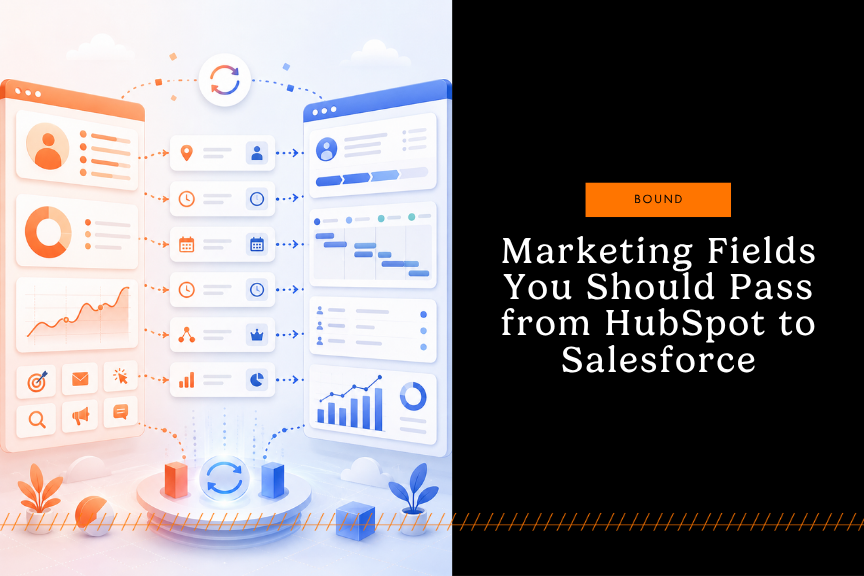
When syncing HubSpot with Salesforce, the most valuable fields are marketing attribution and engagement properties, like Original Source, Latest Source, First Seen Date, and Latest Seen Date. These fields show where leads came from, how recently they engaged, and improve lead prioritization and revenue reporting.
Why HubSpot to Salesforce Field Selection Matters
The HubSpot Salesforce integration connects two systems with very different jobs. HubSpot captures marketing behavior and conversion context. Salesforce runs the pipeline.
But HubSpot properties do not magically become useful in Salesforce unless you intentionally map them. Many teams sync only basics like name, email, company, and lifecycle stage. That creates a contact record, but it does not create decision-grade context.
Marketing fields are what give sales a reason to act. They answer questions like:
- Where did this lead come from originally?
- What channel brought them back most recently?
- When did they first engage, and are they active now?
- Which channels actually produce closed-won revenue?
The Essential Marketing Fields to Sync from HubSpot to Salesforce
Below are the core fields that improve lead prioritization, outreach timing, and attribution reporting.
1. Original Source (First-touch attribution)
What it tells sales: how the prospect first discovered you. Why it matters: first-touch source helps reps understand the initial intent and the story behind the lead.
Examples of use in sales workflows:
- Paid Search original source often signals high commercial intent.
- Organic Search original source can indicate research-stage interest.
- Referral original source can suggest a partner or community influence.
Recommended Salesforce usage: surface as read-only on Lead and Contact layouts so reps trust it as “system-generated.”
HubSpot's traffic source properties documentation provides detailed information on how these fields work and what values they capture.
2. Latest Source (Most recent touch)
What it tells sales: the channel that brought them back most recently.
Why it matters: the latest source reflects current behavior, which is often more actionable than first touch.
Examples of use:
- A lead that originally came from organic but returned via a webinar is a very different outreach conversation.
- The latest source helps reps align messaging with the prospect’s current context.
3. First Seen Date (First website engagement date)
What it tells sales: how long the lead has been aware of your brand.
Why it matters: sales motion changes if someone discovered you today versus 6 months ago.
How it changes outreach:
- New first-seen leads typically need fast follow-up.
- Older first-seen leads may require a “restart the conversation” angle, not a hard close.
4. Latest Seen Date (Most recent engagement date)
What it tells sales: recency and momentum.
Why it matters: recency is one of the simplest ways to prioritize.
Practical triage rule:
- Latest seen within the last 1 to 7 days: prioritize for outreach.
- Latest seen 30+ days ago: treat as re-engagement, not active demand.
How to Make These Fields Actually Visible in Salesforce
Syncing fields is necessary, but not sufficient. If reps cannot see the information where they work, it will not be used.
Create A “HubSpot” Tab on Lead, Contact, And Account Layouts
What to include on the tab:
- Original Source
- Latest Source
- First Seen Date
- Latest Seen Date
- Any additional high-signal marketing fields your team relies on (for example, campaign, conversion page, or last marketing email click date if you track it consistently)
For detailed guidance on logging and tracking activities in Salesforce, see our guide on how to log activity in Salesforce.
Embed the HubSpot Visualforce Component (So Reps Stay in Salesforce)
Embedding the HubSpot record view keeps marketing context inside the CRM, including activity history and key properties. If your org uses HubSpot’s AI features (like Breeze AI chat), this also helps reps ask quick questions about the lead’s journey without switching tools.
Connect Lead Source Data to Revenue with Contact Roles
If your team is not consistently using Contact Roles on Opportunities, attribution will always be incomplete.
Here’s why:
- Marketing source data typically lives on the Lead/Contact record.
- Revenue lives on the Opportunity record.
- Contact Roles create the relationship that lets you report “source to closed-won” with confidence.
Result: real full-circle reporting that answers:
- Which channels create closed-won deals, not just MQLs?
- Which campaigns influence highest ACV opportunities?
- Where should budget move next quarter?
Implementation Checklist (So This Doesn’t Become Another “Integration That Exists”)
- Audit what sales actually needs: prioritize fields that change rep behavior or improve reporting.
- Map only what matters: fewer, high-signal fields beat dozens of unused properties.
- Build the Salesforce layout intentionally: put the HubSpot tab where reps will actually click.
- Pilot with a small group: validate field accuracy and usability before rolling out.
- Document your field mappings: include “what it means” and “how sales should use it.”
What This Unlocks: Data-Driven Sales Execution
When sales have marketing context inside Salesforce, they stop treating every lead the same. They can:
- Prioritize by source quality and engagement recency
- Tailor messaging to the prospect’s discovery path
- Identify re-engagement opportunities sooner
- Produce attribution reporting leadership actually trusts
Bottom line: the integration is only as valuable as the marketing fields you choose to sync and surface.
Want Concept to Set Up Your HubSpot-Salesforce Field Sync the Right Way?
If you want Salesforce to show the marketing context your reps need, without cluttering the CRM with noise, Concept can help. We help clients identify the highest-signal HubSpot fields, map them cleanly into Salesforce, design a Salesforce “HubSpot” tab, and connect contacts to opportunities.
Reach out to Concept to audit your current integration and get a field-sync plan that improves pipeline visibility and reporting.
Partner With Concept
Share your details and our team will reach out to discuss collaboration opportunities