

If you’re navigating today’s revenue landscape, you’ve likely encountered two buzzwords that seem to overlap: “sales engine” and “RevOps.” Both promise to streamline revenue generation, but they’re often used interchangeably, creating confusion about what each does and whether you need one, both, or neither.
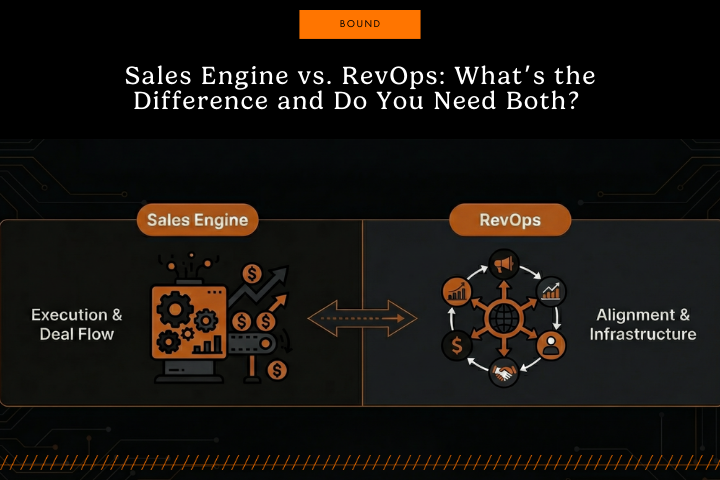
The short answer? They’re complementary, but distinct. A sales engine is the systematic framework that drives consistent deal flow and conversion, while RevOps is the operational infrastructure that aligns your entire revenue organization. In this blog, we break down their differences, how they work together, and which one your business needs.
What Is a Sales Engine?
A sales engine is a repeatable, scalable system designed to generate predictable revenue. Think of it as the machinery that converts prospects into customers through defined processes, automation, and optimization.
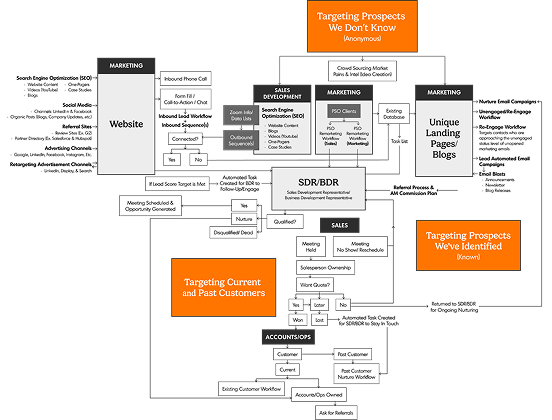
Key components include lead generation and qualification, playbooks, sales automation, and performance tracking. The primary goal is execution, focusing on the mechanics of selling: attracting leads, engaging prospects, closing deals, and measuring results.
What Is RevOps?
Revenue Operations (RevOps) is the strategic alignment of sales, marketing, and customer success teams under a unified operational framework. Rather than solely focusing on sales execution, RevOps takes a holistic view of the entire customer lifecycle.
RevOps breaks down silos by creating shared definitions, metrics, and goals across departments. It establishes a single source of truth for customer data, orchestrates processes across the customer journey, manages your technology stack, and provides unified reporting that reveals the complete revenue performance picture.
What Are the Key Differences?
- Scope: A sales engine is sales-centric, focused on new customer acquisition. RevOps is organization-wide, encompassing marketing, sales, and customer success.
- Tactical vs. Strategic: Building a sales engine is a tactical initiative to improve sales performance. RevOps is a strategic function aligning people, processes, and technology across the revenue organization.
- Metrics: Sales engines track pipeline velocity, conversion rates, and quota attainment. RevOps monitors CAC, LTV, net revenue retention, and cross-functional efficiency.
How Does RevOps & Sales Engines Work Together?
Your sales engine is the execution layer, the machine that converts qualified leads into closed deals. RevOps is the enablement layer ensuring your sales engine has clean data, qualified leads from marketing, smooth handoffs to customer success, and integrated technology.
RevOps amplifies your sales engine’s effectiveness by removing friction and providing better inputs. Your sales engine provides RevOps with execution insights that inform strategic decisions about resources, processes, and technology investments.
Do You Need Both?
You need a sales engine if:
- Sales results are inconsistent despite talented reps
- You lack documented processes for deal progression
- New hires take too long to ramp up
- Revenue forecasting is unreliable
- Manual tasks consume significant selling time
You need RevOps if:
- Marketing and sales disagree about lead quality
- You have disconnected systems creating data silos
- Teams optimize for their own metrics, not company revenue goals
- Cross-functional misalignment creates customer experience problems
You need both if:
- You're scaling beyond founder-led sales
- You've achieved product-market fit and need repeatable processes
- You're investing in technology without proportional returns
For early-stage startups, building a sales engine often comes first. As you scale, RevOps becomes critical to prevent silos from undermining growth. For enterprises, RevOps might be the priority if departmental silos have created organizational debt.
RevOps & Sales Engines: Complementary Capabilities
Sales engines and RevOps aren’t competing strategies; they’re complementary capabilities. Your sales engine ensures repeatable conversion systems. RevOps ensures that those systems operate within an aligned, efficient, data-driven organization.
The executives who win understand they need both the execution machinery and strategic infrastructure that turns revenue generation from an art into a science.
Ready to Build a Scalable Revenue System
Whether you need to optimize your sales engine, implement RevOps best practices, or create alignment between both, Concept helps B2B companies build predictable, scalable revenue operations. Our team helps eliminate guesswork and creates a systematic approach your business needs to grow.
Let’s talk about your revenue challenges. Contact Concept to discover how we can help you build the infrastructure for sustainable growth.
Partner With Concept
Share your details and our team will reach out to discuss collaboration opportunities