

HubSpot's Agentic Automation Builder: Bringing AI Agents and CRM Together
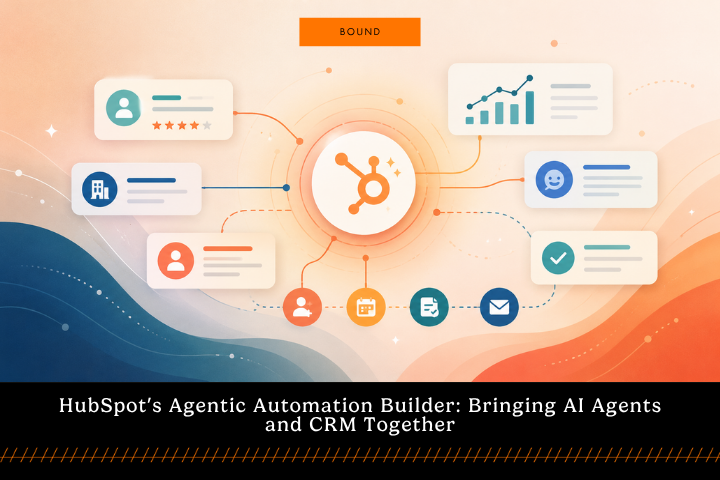
HubSpot has released a new Agentic Automation Builder, currently in private beta. It lets teams build AI agents that read and write CRM data directly, instead of wiring AI and workflows together as two separate systems.
What Is the Agentic Automation Builder?
The Agentic Automation Builder lets you create custom AI agents that interact directly with CRM data. Instead of building workflows and AI capabilities separately, it merges them into one interface. Teams can build agents that read context, make decisions, and take actions in the CRM without manual steps.
Traditional workflows follow predefined paths based on triggers and conditions. An agent can interpret information, reason through a scenario, and adjust based on what it finds in your CRM.
Why This Matters for Your Team
Sales teams spend hours on repetitive work: updating records, qualifying leads, scheduling follow-ups, flagging opportunities that need attention. An agent can handle these autonomously, so reps spend their time on relationships and deals.
Take a common case. A lead fills out a form, and someone has to decide whether they are qualified, assign them to the right rep, and schedule a first call. Normally that is several workflow steps plus manual review. An agent can score the lead against your criteria, route it, and trigger the next step on its own.
If you already use HubSpot's lead scoring capabilities, this builds on that foundation. Instead of scoring leads by hand, agents can act on those scores.
How It Works
The builder brings together three core components:
- Custom AI agents: You define what the agent should do. Qualify leads by company size and industry? Analyze customer sentiment from recent interactions? The agent learns your business logic and applies it consistently.
- CRM data access: The agent does not operate in isolation. It reads and writes to your HubSpot records, pulling context from accounts, contacts, deals, and custom objects, so decisions are based on current information.
- Workflow automation: Once an agent makes a decision or finishes a task, it can trigger downstream actions: send an email, create a task, update a field, notify a team member. The agent becomes part of your broader automation.
- Lead qualification: Agents evaluate incoming leads against your ideal customer profile, then score and route high potential prospects to your best reps.
- Account health monitoring: An agent scans account activity continuously, flagging at-risk customers or surfacing upsell opportunities based on usage and engagement history.
- Meeting preparation: Before a scheduled call, an agent can pull relevant account history, recent interactions, and open opportunities into a brief for your rep. This complements HubSpot's Revenue Hub, which provides unified visibility into the revenue process.
- Data hygiene: Agents can identify duplicate records, flag incomplete data, and suggest corrections, keeping your CRM clean without manual effort. That matters most when connecting HubSpot to other systems.
The Broader Shift in Automation
This launch reflects a broader trend: automation moving from rigid, rule-based workflows to adaptive systems. That matters because business rarely follows one path, and rule trees break the moment a situation falls outside them.
Agents handle that ambiguity. They read context and adjust instead of following a fixed script. For HubSpot teams, automation starts to behave less like a checklist and more like delegated work.
The shift tracks how search and AI are changing more broadly. As AI reshapes how businesses discover and engage customers, intelligent systems inside the CRM matter more.
Getting Started
The Agentic Automation Builder is in private beta, so access is limited. To test it, you can request access through HubSpot's product updates portal. Early adopters get to shape how the tool evolves before it ships widely.
For teams already familiar with HubSpot's workflow builder, the learning curve is short. The interface follows similar patterns, with new options for defining agent behavior and decision logic.
What's Next
As the tool matures, expect agents that handle service inquiries, manage contract renewals, or flag which deals are most likely to close.
For now, the Agentic Automation Builder is a real step forward. It treats AI as part of the automation layer instead of a bolt-on, giving sales and marketing teams a system that can decide and act, not just follow rules.
Want Help Putting Agents to Work in Your HubSpot?
Concept is a HubSpot solutions partner. Our team can help you scope the right agent use cases, get your CRM data clean enough to trust, and build the workflows around them, so the automation holds up in production.
Talk to Concept’s HubSpot Team →
Partner With Concept
Share your details and our team will reach out to discuss collaboration opportunities