


Separating prospecting and closing roles helps companies build a more predictable revenue engine by keeping pipeline generation consistent, even when active deals demand attention. When one salesperson owns every stage of the sales process, prospecting often suffers, and future revenue becomes harder to forecast.
On paper, asking salespeople to handle everything can look efficient. One person finds leads, books meetings, runs demos, follows up, negotiates, and closes the deal. That structure often creates hidden risk.
The issue usually is not talent. It is capacity and focus. Prospecting and closing require different mindsets, different skills, and different rhythms. When the same person is responsible for both, one priority almost always wins.
Usually, it’s closing. That makes sense. Active deals feel urgent. Prospects waiting on proposals need attention. Pipeline reviews put pressure on late-stage opportunities. Closing business feels like the highest-value use of time.
But when prospecting gets pushed aside, the company quietly trades future pipeline for current revenue.
The Prospecting vs. Closing Problem
Salespeople naturally gravitate toward work that feels closest to revenue. If there are demos to run, proposals to send, and decisions to move forward, those activities take priority. Prospecting rarely feels as urgent.
A cold call can wait. An email sequence can be delayed. A new account list can be reviewed tomorrow. The consequences are not immediate, which is exactly why the problem is so easy to miss.
Prospecting is the activity that creates future opportunities. When it slows down, your future pipeline starts shrinking before your reports show a problem.
For a while, everything can look healthy. Deals keep moving. Forecasts look stable. Revenue may even grow. Then the sales cycle catches up.
Pipeline Is a Lagging Indicator
One of the most important sales management lessons is simple: pipeline does not show today’s prospecting effort in real time. Pipeline is a lagging indicator.
The outbound work your team does this month may not become visible pipeline for 60, 90, or 120 days, depending on your sales cycle. That means a drop in prospecting activity can stay hidden for months.
By the time leadership notices that pipeline is thinning, the real cause may have happened much earlier. That creates a dangerous blind spot. A company may feel confident because the current pipeline looks strong, while the activity needed to create the next wave of pipeline has already slowed.
The business is living off yesterday’s prospecting.
The Revenue Cycle That Keeps Repeating
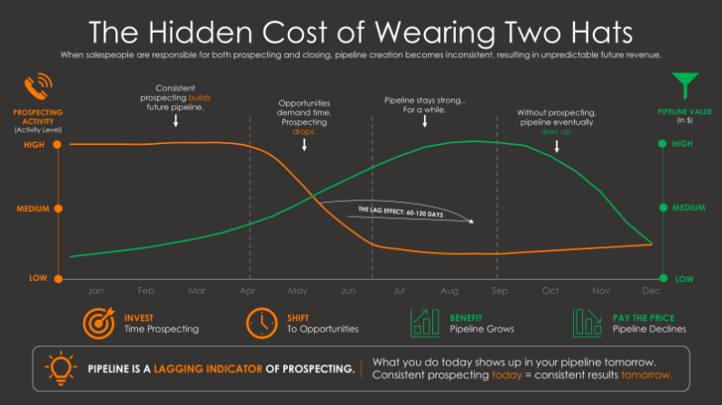
When prospecting and closing sit with the same person, many sales teams fall into a predictable pattern.
Stage 1: Prospecting Is Consistent
Salespeople dedicate real time to outbound activity. Calls are made. Emails are sent. Conversations happen. Meetings get booked.
Pipeline begins to build because the front end of the sales process is active.
Stage 2: Focus Shifts to Active Opportunities
As more meetings turn into sales opportunities, the salesperson’s attention moves to discovery calls, demos, proposals, and follow-up.
Prospecting starts to decline. At first, the change may look small. A few fewer calls. A few skipped outreach blocks. A few delayed follow-ups. But small drops in activity create future pipeline gaps.
Stage 3: Pipeline Still Looks Healthy
Because pipeline lags behind activity, everything appears fine for a while. Leadership sees opportunities in the system. Forecasts look solid. The team feels busy.
The problem is already forming underneath the surface. Prospecting has slowed, but the impact has not appeared yet.
Stage 4: Pipeline Dries Up
Eventually, the lack of prospecting shows up. New opportunities slow down. Pipeline coverage shrinks. Forecasts become less reliable. Revenue growth stalls.
Now the team has to scramble back into prospecting mode to rebuild pipeline. Then, once enough opportunities are created, attention shifts back to closing, and the cycle starts again. This is why revenue can feel inconsistent even when the sales team is working hard.
The Real Cost of Unpredictable Revenue
Unpredictable pipeline affects more than the sales department.
When future revenue becomes harder to see, leadership has less confidence in the business. Hiring decisions become more difficult. Marketing performance becomes harder to evaluate. Cash flow planning gets less reliable. Growth targets become more stressful to manage.
Investors, executives, and stakeholders do not only care about revenue. They care about whether revenue can be repeated. A company with inconsistent prospecting may still close deals, but it will struggle to build a dependable growth model.
Why High-Growth Companies Separate Prospecting and Closing
High-growth companies often separate prospecting from closing because specialization creates consistency. Business Development Representatives, or BDRs, focus on outreach, qualification, and meeting generation. Account Executives focus on discovery, demos, proposals, negotiations, and closing.
This structure protects pipeline creation. When Account Executives get busy with active deals, prospecting does not stop. BDRs continue creating conversations and booking meetings. That keeps the top of the funnel active and reduces the risk of future pipeline gaps.
It also allows each role to improve faster. BDRs become stronger at targeting, messaging, objection handling, and qualification. Account Executives become stronger at diagnosing needs, building value, managing stakeholders, and closing revenue.
A generalist sales role can work in the early days of a company. But as growth targets increase, specialization often becomes the difference between occasional sales momentum and a repeatable revenue engine.
What Sales Leaders Should Measure
To build predictable revenue, leaders need to measure more than closed deals and current pipeline.
Revenue is a lagging indicator. Pipeline is also a lagging indicator. Prospecting activity is the leading indicator.
Track the metrics that reveal whether future pipeline is being created:
- Prospecting activity
- Conversations started
- Meetings booked
- Qualified opportunities generated
- Pipeline created per month
- Conversion from meeting to opportunity
- Pipeline created by source
These metrics act like an early warning system.
If prospecting activity drops, leadership can respond before revenue is affected. If meetings booked decline, the team can investigate messaging, targeting, list quality, or activity levels. If pipeline creation slows, leaders can address the issue before the forecast becomes a problem.
A healthy sales organization does not wait for revenue to miss. It watches the inputs that create revenue.
FAQs
1. Why should prospecting and closing be separate roles?
Prospecting and closing should be separate roles because each requires focused time, different skills, and consistent execution. When one salesperson owns both, prospecting often gets deprioritized when active deals need attention, which can weaken future pipeline and make revenue less predictable.
2. What is the difference between a BDR and an Account Executive?
A Business Development Representative, or BDR, focuses on generating pipeline through outreach, qualification, and meeting setting. An Account Executive focuses on advancing qualified opportunities, running discovery and demos, managing proposals, negotiating, and closing deals.
3. How does separating sales roles improve revenue predictability?
Separating sales roles improves revenue predictability by keeping prospecting activity consistent, even when closers are busy with active opportunities. This helps prevent gaps in pipeline creation and gives sales leaders better visibility into future revenue.
4. What sales metrics should leaders track to prevent pipeline gaps?
Sales leaders should track leading indicators such as prospecting activity, conversations created, meetings booked, qualified opportunities generated, and pipeline created per month. These metrics help identify pipeline risk before it shows up as missed revenue.
The Bottom Line
Consistent prospecting creates consistent pipeline. Consistent pipeline creates predictable revenue. When salespeople are responsible for both prospecting and closing, prospecting is often sacrificed because active deals feel more urgent. The impact is delayed, which makes the problem harder to catch. But eventually, the pipeline reflects the lack of activity.
Separating prospecting and closing helps companies protect the front end of the sales process, improve role focus, and build a more stable revenue engine. For companies trying to scale, that consistency matters. Predictable revenue gives leaders the confidence to hire, invest, forecast, and grow with greater control.
Build a More Predictable Sales Engine with Concept
If your pipeline feels inconsistent or your sales team is constantly switching between prospecting and closing, Concept can help you identify the structural gaps holding revenue back.
Concept’s sales consulting services help companies evaluate their sales organization, improve pipeline generation, and build repeatable systems for predictable growth. Reach out to our team today.
Partner With Concept
Share your details and our team will reach out to discuss collaboration opportunities